Medical Records
Medical Record Retrieval Challenges and Their Impact on Healthcare Operations
An appointment with a specialist starts in just one hour. Now your team has the referral, but that imaging report still hasn't shown up. Someone is calling the office that referred the patient again, and the doctor keeps checking the chart. All while the patient just sits there waiting.
This small example shows how a missing record can disrupt work far beyond the records department. For those leading healthcare organizations, medical record retrieval needs real attention since it changes how fast teams can actually act on data. A request might seem finished in your tracking system, even though the person who needs the paper still can't use it. Where exactly is that gap happening in your own organization?
Why Retrieving Records Takes Way Longer Than You Think
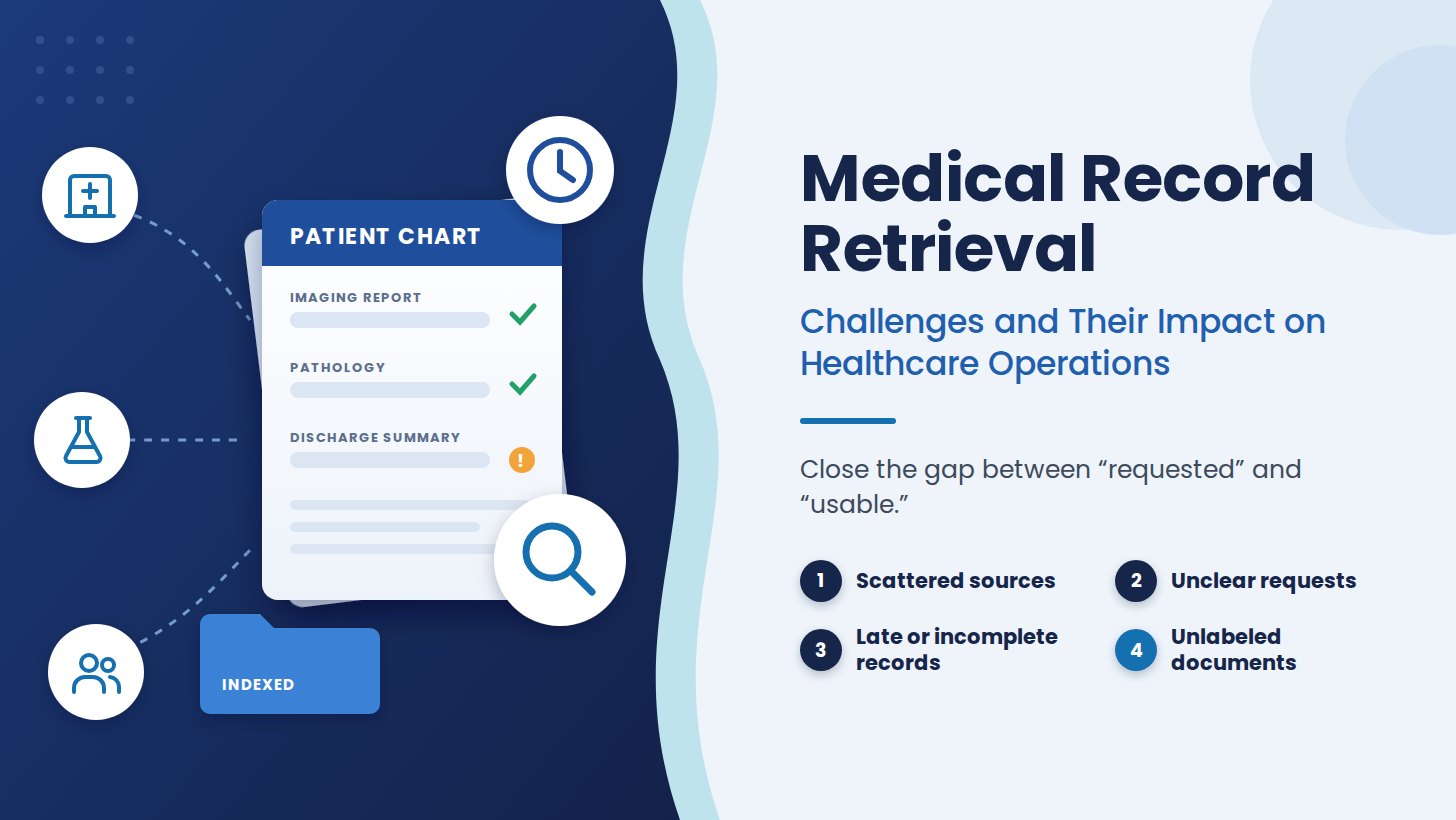
Patient information can be scattered across different hospital systems, specialist offices, labs or even outside storage companies. Every single source might have its own unique way of doing requests. This means your staff has to figure out the right person to talk to and be very specific about what documents are needed. Even small gaps lead to mountains of extra work. Asking for recent records might get you office notes but not the actual pathology report the doctor is looking for. Also, a wrong date range can cause a whole new request to be sent.
Getting access is another big deal. Employees need ways to ask for and get information that is already approved, plus they need clear directions on how to handle release laws. Without these instructions, staff may stop the request or send it through the wrong channel. More follow-up won't fix a request that was unclear to begin with.
How These Retrieval Issues Mess With Daily Tasks
The kind of operational hit you take depends mostly on who wants the record and what they plan to do with it. If outside records show up after the appointment, the clinician might have to have another conversation or visit just to finish the assessment. To fix this, check if records are available before the visit happens and flag whatever is missing.
When supporting papers stay incomplete, reviewers might need more information before they can decide on an authorization. The best move here is specifying the exact report and service date when first asking for records. If staff cannot find the paperwork for a claim review, billing teams waste huge amounts of time searching, which slows down their responses. Try linking the retrieval request directly to the claim and the deadline for the response.
And then there are documents that arrive without any clear labels. This forces employees to open files repeatedly just to see what is inside. Indexing records by date and document type solves this. These headaches also hurt how you talk to patients. If your team can't tell a patient what is missing or who is following up, the patient might start calling five different offices to get an answer.
| Retrieval problem | Potential operational impact | Practical response |
|---|---|---|
| Outside records arrive after an appointment | The clinician may need another conversation or visit to complete the assessment | Check record availability before the visit and flag missing documents |
| Supporting documentation remains incomplete | Reviewers may need more information before making an authorization decision | Specify the required report and service date when requesting records |
| Staff cannot locate documentation for a claim review | Billing teams spend more time searching, which can delay their response | Link the retrieval request to the claim and its response deadline |
| Documents arrive without clear labels | Employees repeatedly open files to identify their contents | Index records by document type and date |
Deciding What Actually Counts As Complete
Just getting a file shouldn't be enough. There needs to be a quality check before the team marks the request as closed. Give your staff a quick checklist to use:
- Make sure the records actually belong to the right patient.
- Look at the document types and the dates that were asked for.
- Find any duplicates or scans that are unreadable or missing pages.
- Put the papers in the right spot in the chart.
- Tell the person or department that was waiting for them. For instance, a discharge summary might arrive, but it doesn't have the med list the care team wanted.
If you close the request, then you're just leaving the next worker to find the mistake. It makes sense to put one person in charge of fixing these incomplete responses. Make sure there is backup help so that a sick day doesn't stop the follow-up process.
Looking at the Real Effort Behind Every Request
Turnaround time tells you the wait time, but it doesn't show how much actual staff time went into it. Imagine a practice that deals with 200 requests a month. If every single one needs ten more minutes of hunting or calling, that adds up to over 33 hours of staff time every month.
You should track follow-up attempts along with the total time from the first request until the record is actually usable. It is important to separate delays coming from the outside office versus time spent sitting in your own internal queue. Every week, try reviewing a sample of the requests that are overdue. Search for specific reasons like old contact info or files that came in but never made it to the chart. Once you find those triggers, you can change the actual steps being taken.
Putting Help Where Things Get Stuck
If your staff is juggling retrieval between answering phones and working the front desk, requests might just sit there during the rush. Having dedicated support lets this work get steady attention.
Global Clinical Services provides management and processing for medical records, which includes both retrieval and indexing. Our support for physician groups also covers administrative help and managing documentation. Start with a narrow focus, like outside records for upcoming specialist visits. Decide who is doing the requesting, who is checking the work and when a stuck request needs to be escalated.
Reach out to Global Clinical Services to chat about support for your record retrieval load and which parts of the process need more consistency!